Payment Detail
Use this page to view and manage a payment record after it has been created. The payment detail page displays all components of a payment—payment information, check and client selection, notes, and transaction status—with buttons to edit, view history, and manage the payment. Editing capabilities depend on the payment status.
Summary
Use this page to verify payment records, monitor status-based restrictions, and review reconciliation details. It supports controlled edits while preserving audit integrity.
When to use this page
- Viewing a complete payment record with all transaction information
- Checking payment status and financial impact
- Modifying payment details (if status permits)
- Linking or unlinking a payment from a bank check
- Reviewing the payment history and change log
- Validating payment amounts before reconciliation
How to access this page
From the sidebar, go to Trade → Payments. On the Payments List page, click on any payment reference number or select a payment to open the Payment Detail page.
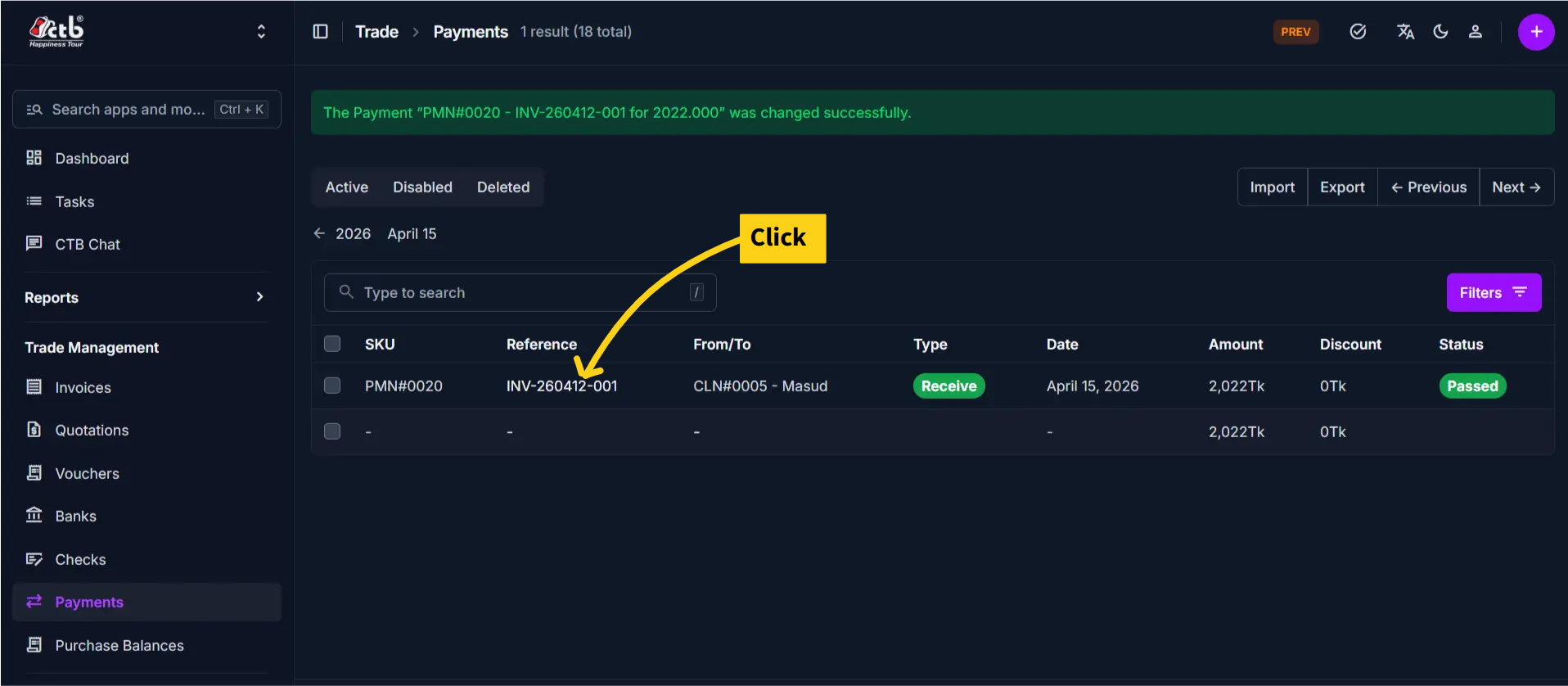
The page displays the payment record with all transaction details and action buttons at the top.
Step-by-step instructions
- Open Trade -> Payments and select the payment record.
- Review current status to confirm what can be edited.
- Verify payment amount, date, reference, and linked party.
- Check whether a linked check is affecting both balances.
- Update allowed fields or notes if needed, then save changes.
Field reference
- Status - Payment lifecycle state and permission controller.
- Type - Receive or Send transaction direction.
- Reference - Traceable identifier for reconciliation.
- Amount - Recorded payment value.
- Check - Optional check linkage that can affect both check and party balances.
- Client/Vendor - Counterparty linked to the payment.
Page Overview
The payment detail page includes action buttons at the top-right:
| Button | Action | Available When |
|---|---|---|
| Edit | Open edit mode to modify payment fields | Pending status |
| Delete | Remove the payment from the system | Pending or Failed |
| History | View past changes and modifications | Always visible |
Status Controls Permissions
Only payments with Pending or Failed status can be edited or deleted. Once a payment is marked Passed, it becomes read-only to protect financial records.
Payment Information Section
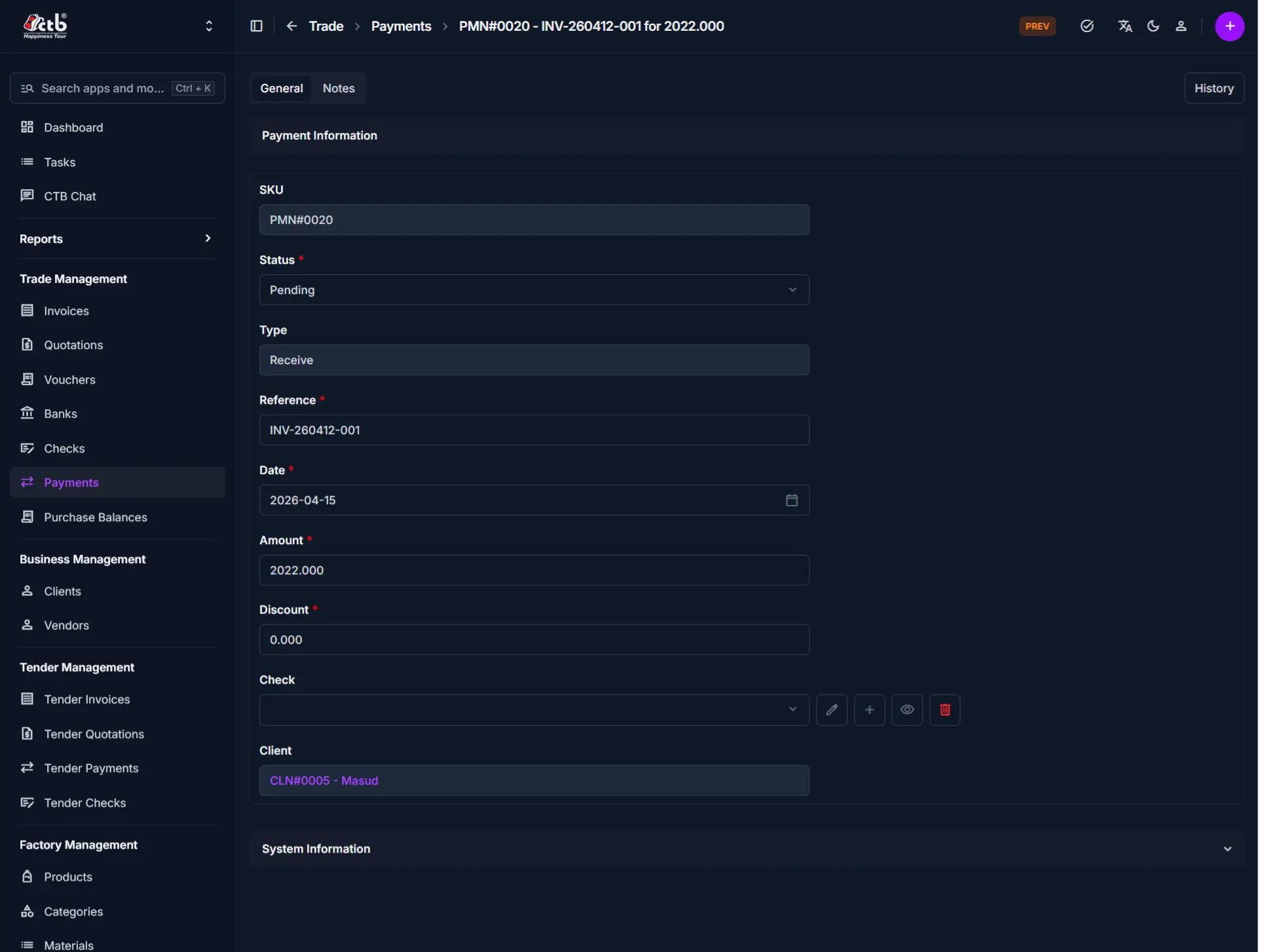
The Payment Information section displays core transaction details:
| Field | Description | Editable When |
|---|---|---|
| SKU | Unique identifier for this payment (auto-generated) | Never |
| Status | Current state (Pending, Passed, Failed) | Pending only |
| Type | Receive (from client) or Send (to vendor) | Never |
| Reference | Reference number or transaction ID for tracing | Pending only |
| Date | Date the payment was made or received | Pending only |
| Amount | Total payment amount in the default currency | Pending only |
| Discount | Discount or adjustment applied (if any) | Pending only |
Status Restrictions
Once a payment is marked Passed, critical fields like Amount and Date become locked to preserve the original transaction record. Pending payments are fully editable.
Check and Client Selection Section
This section shows the parties involved in the payment:
| Field | Description | Editable When |
|---|---|---|
| Check | Bank check associated with this payment (if any). Selecting a check affects two balances. | Pending only |
| Client | The client or vendor involved in the payment (customer or supplier) | Never |
Check Impact on Balances
When a Check is linked to a payment, the payment amount reduces both the client/vendor balance AND the check balance. If no check is linked, only the client/vendor balance is reduced.
Notes Section
The Notes section contains internal comments and remarks:
| Field | Description | Editable When |
|---|---|---|
| Notes | Internal notes, remarks, or special conditions | All statuses |
Tip
Use Notes to document payment terms, special instructions, reasons for discounts, or any other internal details related to the payment.
Status and Permissions
Payment management capabilities vary based on status:
| Status | View Access | Edit Access | Delete Access | Restrictions |
|---|---|---|---|---|
| Pending | Full | All fields | Yes | None; fully editable |
| Passed | Full | Status and Notes only | No | Cannot modify amount, date, client, or check |
| Failed | Full | View only | Yes | Locked; preserves original reconciliation data |
Protect Passed Payments
Once a payment is marked Passed, it cannot be edited or deleted to ensure financial integrity and accurate reconciliation.
Related Actions
| Action | Button/Link | When to Use |
|---|---|---|
| Edit | Edit button | Modify details for Pending payments only |
| Delete | Delete button | Remove Pending or Failed payments |
| Add Note | Notes field | Add internal comments or remarks (all statuses) |
| View History | History button | Review who changed what and when |
| Go Back | Back button | Return to the Payments list |
Tips and common issues
- Cannot edit a Passed payment? — Once a payment is marked Passed, it is locked. Only Status and Notes can be changed. Create a new adjustment payment if you need to modify the amount or date.
- Delete disabled for Passed payments? — Passed payments cannot be deleted to preserve the audit trail. Mark the payment as Failed first, then delete if needed.
- Check linked to two balances — Remember that selecting a check affects both the client/vendor balance and the check balance; leaving Check empty only affects the client/vendor balance.
- Need to correct a Passed payment? — Do not attempt to modify a Passed payment directly. Instead, create a new correction payment with the opposite amount.
- Always save before leaving — When editing, use the Save button at the bottom to apply changes. Unsaved edits will be lost.